

The First and the Last
“...mad as the sea and wind when both contend which is the mightier” (Hamlet iv.1)

I was traveling this week, and while away from home I did two things (among many others): I spoke with a friend about creative writing, which as a devoted essayist I don’t do much of, and I went for a swim in a lovely lake—in slacks and a long-sleeve shirt, because that’s what I was wearing, and I had no other clothes. These two experiences, I suppose, reminded me of a short story that I wrote years ago and never published.
So please find below, in lieu of the nonfiction essay I had planned to send out today, a revised version of that short story. I hope you enjoy it. This is my first time, and might be my last time, publishing prose fiction through Substack.
“Impossible. I won’t allow it. Would never allow it.” Losing composure; such was the state of the man, still vigorous but neither young nor youthful. The shape of his brow was like faraway birds in a child’s drawing. He made some reference to an insult. You’re insulting me, was the idea conveyed, but the words were indistinct.
“I’ve never insulted you,” replied his son. It was true enough, for he said little—why speak when one is not listened to? If one must speak alone, or to those who make us feel alone by turning company into crowded solitude, it is better to sing. “But you hate her family, not her. And I don’t hate anyone.” Again, quite true. She who did nothing to offend the father nonetheless had “incurred his displeasure,” as the phrase goes, though the father would not have used it. His words, like his patience and his hair, had grown shorter and grayer over the years. And the boy had no aptitude for hatred.
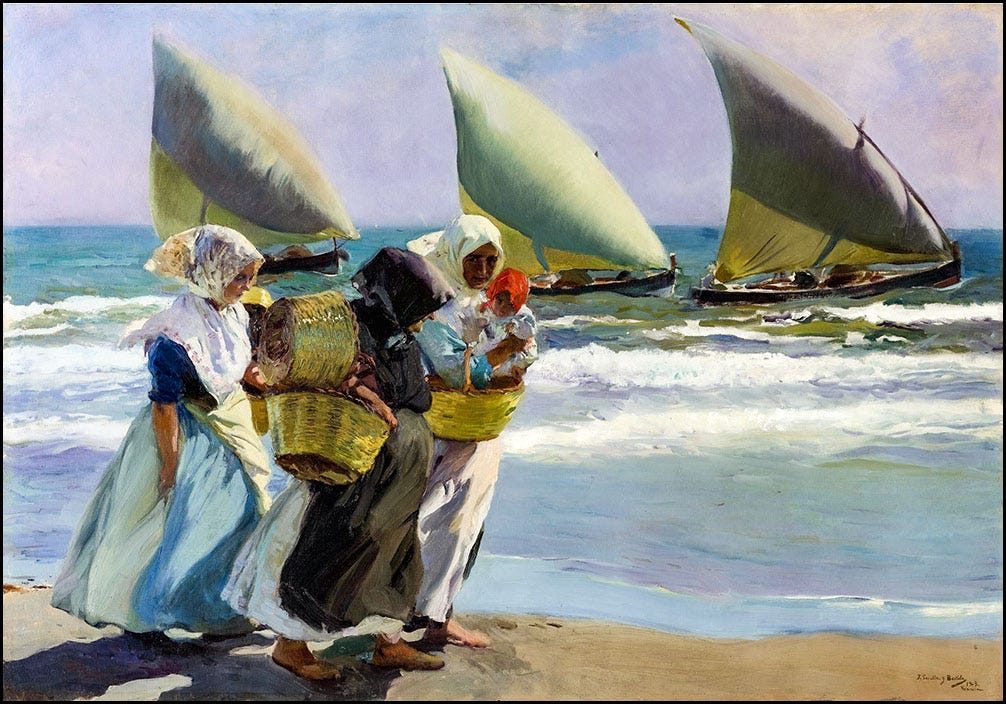
It was late afternoon—sun shining, sea glistening, waves rolling gently. The view was like a Sorolla painting, but farther north, where the waters and the hearts are colder. The boy’s eyes were looking outward, his home and family behind him; his words, though uttered with voice enough to be heard, were looking inward. “What will I do, then?” To this the father replied (though the question was not for him), “What about…?” He offered a name, more or less at random since he didn’t really care. The boy mumbled something, a vague statement of disapprobation, and then a few more names were proposed, with the same result. The conversation, futile in the extreme, dwindled into sound without fury, signifying nothing.
At length the boy turned around. “Name them all, then. Every girl in town. This one’s attractive you say, that one’s charming, the others come from wealthy families—and it’s all chaff to me, scattered in the wind. You know the one I love. And you know your petty quarrel with her family is a poison that sickened you and is infecting me.” And it’s all true—his father knew these things. And yet he was unmoved, because his heart had grown heavy with the sorrows of life.
The boy had a streak of boldness that glinted from time to time. In the distance, as he spoke, was thunder: “Will you answer a question, Father? Will you answer it sincerely?” (He had a habit of insincere responses, but we must be understanding: the man had suffered greatly, and thus did he protect himself. The girl’s family had indeed treated him unjustly, but the healthy reaction to injustice is anger, not hatred. It was Augustine who observed that hatred is anger grown old and deep-rooted.) Having waited the customary length of time for a response, and receiving none, the boy ventured the question: “Have you forgotten what it is to love?” The asker waited as the other pondered. “No,” was the reply. “I remember when I loved your mother. And see what has come of it. Envious neighbors and an ungrateful son.”
Clouds, shaped like the prow of an immense ship, not quite blue but not quite gray either, sailed toward the land as the boy walked painfully away.

A storm of emotions in his mind, a storm of winds and waves upon the sea; such was the state of the boy, already weary but neither old nor aged. Vice, even when not your own, has a way of draining life. With leaden feet he walked, making a melancholy path of flattened wildflowers, there among the great rocks that some even greater hand had placed, or so it seems, along the shore. It was a place he went to think, by which I mean a place to not think, which is often what we do in such times as his because what we really need to do is feel, rather than think. And what he felt at this moment—presumably prompted by a sound that reached his ears yet verged on the inaudible—was something amiss, out there in the wrathful sea.
Tempests arise quickly because they are captivating. Magnificent like God, and powerful like the gods, they hold your gaze, and they deceive you, because the danger is near but looks distant. When you feel the first raindrops on your forearm, it’s too late.
Of course it was her. If you deem it improbable, you perhaps have not read closely the story of your own life. Everyone in town had little wooden boats, for fishing or pleasure or just to get from one place to another. She may have been coming to meet him, though I doubt it, because for that she preferred to walk—the journey by land taking longer, she had more time for joy in expectation.
Of course it was her. And of course the boat was sinking; stormy waves flood such a craft with ease. He knew the sight—sheets of rain, leaping swells, a foundering boat—and listened. The storm was singing now, a hollow and ominous song he knew well. One doubt remained: Is it adrift, torn from its moorings and dragged out to die alone, or is someone in it? The answer came when he heard her voice.
Most likely, had you been there, you would have heard the splash but not seen the dive—it was too fluid, too swift, too natural. Thunder rolled as his youthful frame coursed strong and agile through the water, toward the boat, or rather toward the girl; he, like his friends, had grown up swimming as others grow up running. Man, even when his blood is as salty as this boy’s, does not move through water as the sea-beasts do. But that makes the sight of a fine swimmer all the more beautiful, for there is a poetry in swimming when one’s body is made for walking, just as there is a poetry in verse when one’s mind thinks in prose.
If you’re a swimmer, you know: the distance is greater after you begin to swim. The current was relentless, and even such a youth as this must eventually succumb to fatigue. He paused, hardly able to tread water in those conditions, and looked back toward shore. A strange thought, light but not fleeting, cast a shadow upon his mind.
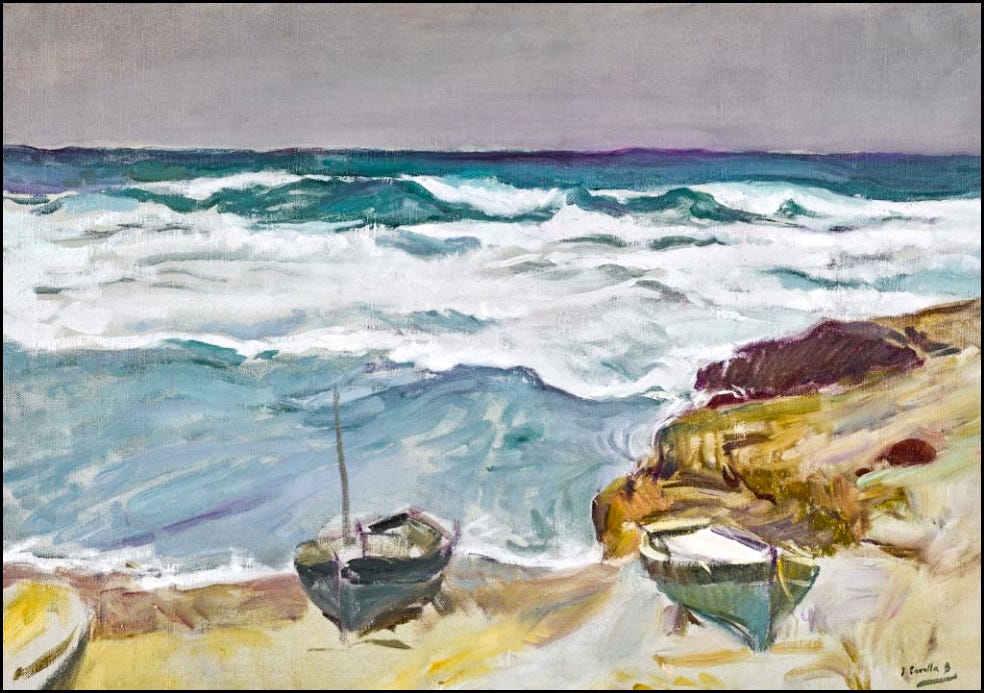

He neared the boat, cold and tired but not quite dead. She held fast to what remained above the water line, desperate and nauseated by shortness of breath. There they met, alone, and there they spoke, all broad smiles and dancing eyes among the rude interruptions of so much watery violence. At first all she could say was his name. And then, “You found me.”
“Yes,” said he, “though I was not seeking you.”
“And still,” said she, “you found me.”
He could not continue: she was overwhelmingly lovely—dark wet hair hanging in sublime elegance around her slender face, and two eyes as jewels glowing in the fey light of the storm. A wave crashed down upon them, but he held her hand, and together they rose and fell with the heaving of the waters. Where exactly the conversation might go from here, he was not sure; words he did not have; his mind, instead, turned and returned to one thought as he saw her, and loved her: I am in paradise.
The rain fell thickly, and they could not see the land. She was not a strong swimmer. He was exhausted. The boat was gone. But they spoke not of such things: why spoil an evening together, simply because they had no hope of reaching the shore? The wind howled, but they were quiet, until she said hopefully, “What did your father say?”
It was a question he expected, though the circumstances of its asking were not what he had first imagined. An answer, already prepared, came to his mind, but a wave from behind knocked those words into the gray and roiling abyss that surrounded him. He wiped the water from his eyes, thought more kindly of his wounded father, and tried again:
“He said that he has not forgotten what it is to love.”
The sun rose in the girl’s face, and in her elation she threw her arms around his sinking neck and pressed her lips to his: their first kiss, and their last. He felt a single teardrop trickle down her cheek before all was water, and he heard one word echoing in his soul before all was silence: “Paradise…”
I would like to read another story, were you to write one. I liked this one very much.
Very good, if dense. Fudge must be consumed more slowly and in smaller quantities than brownies.
It’s funny to me that fiction seems to communicate something so much deeper than non-fiction. Why is that?
I live with several melancholic souls who are mysterious to me, so I appreciate this delightful peek into the melancholic heart. Thank you for it. I’ll take this sentence with me: “Vice, even when not your own, has a way of draining life.”
May God bless you, Mr. Keim!