

Longfellow’s Lost Village
rediscovering meter in “Evangeline: A Tale of Acadie”

Note to readers: The Imaginative Conservative recently published an interview in which I respond to various questions about medieval culture. The questions were posed by Robert Lazu Kmita, whom many of you know through his Substack publication Kmita’s Library. I think the interview turned out really well, and I encourage you to read it if you have time:
“The Medieval Way,” by Robert Lazu Kmita and Robert Keim
I was reminded last week of the poem Evangeline, by the great American poet Henry Wadsworth Longfellow. The work is a compelling allegory that I do not think was intended by its author to be allegorical. It is also a highly illustrative case study in poetic meter. And it aligns perfectly with our recent reflections on village life. Thus, I thought the poem a fitting topic for today’s essay.
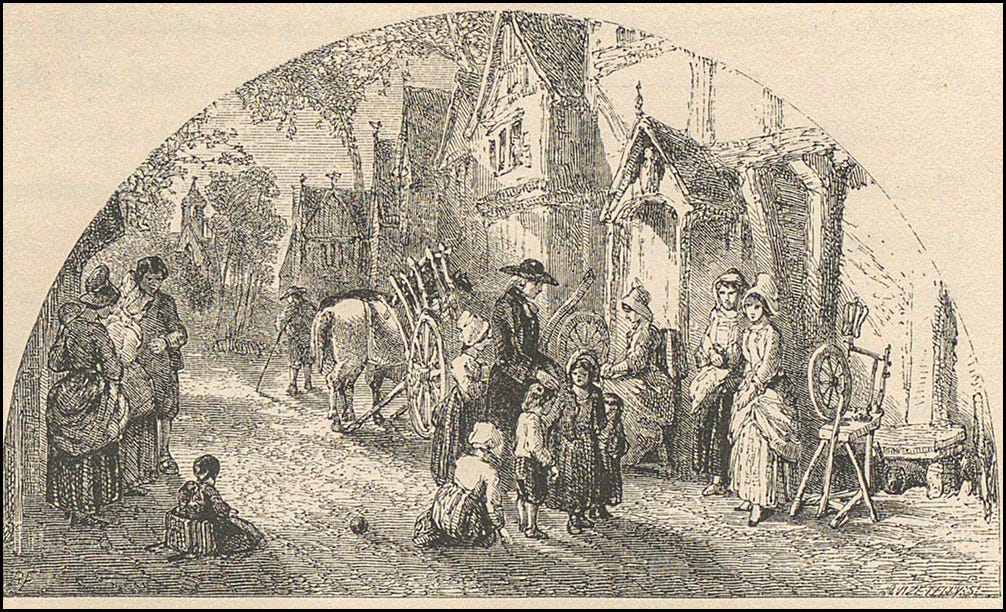
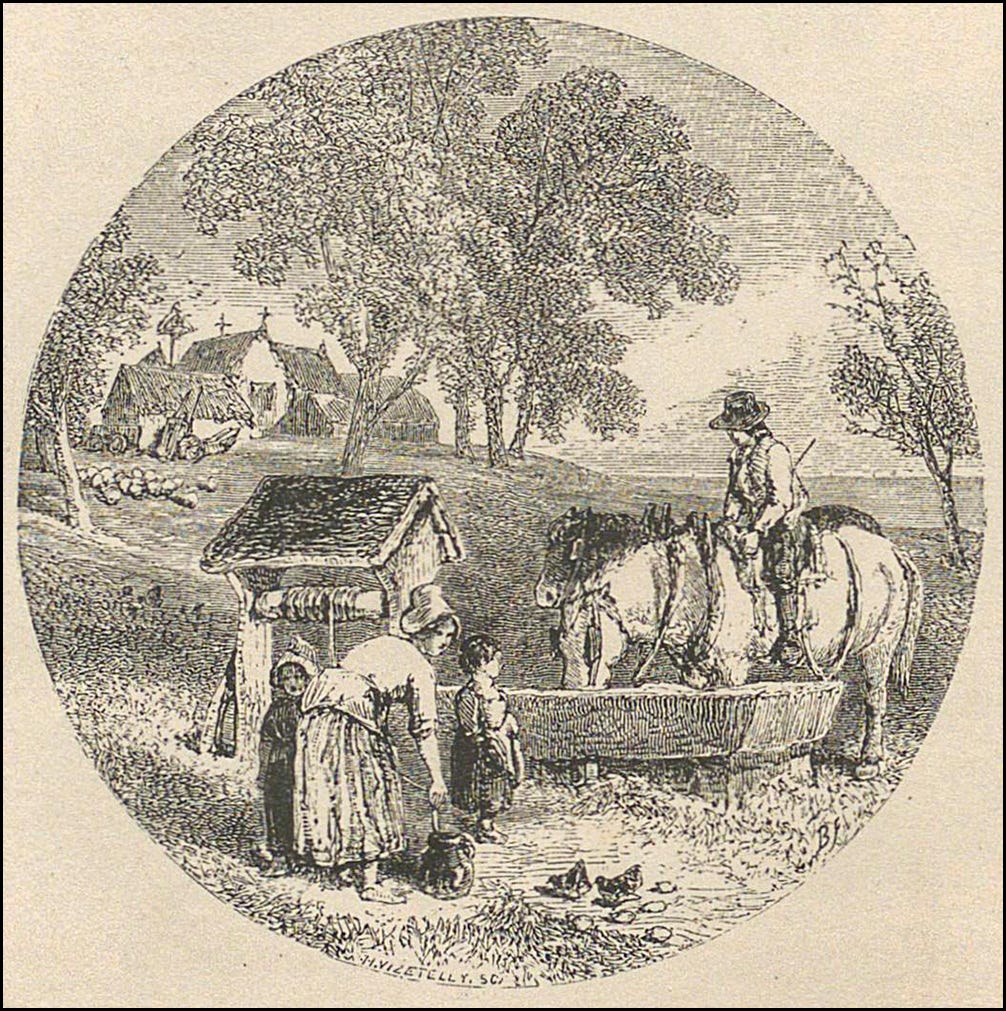
At the very least, Evangeline gives us an opportunity to remember a time—and not so long ago!—when a poet’s choice of metrical form could generate a significant amount of controversy. Nowadays, in contrast, meter is ignored almost as much by poets as by the general population, unless by “meter” is meant the SI unit for distance. Such is life in the twenty-first century: a college graduate may know that the acceleration due to gravity (neglecting air resistance, of course) is 9.8 meters per second per second, and may not know anything of substance about the meter through which Shakespeare created the most immortal and influential works of literature, perhaps the most immortal and influential works of art, in history.
If poetic meter is not something that you’ve had much opportunity to study, I hope you can find time to read (or reread) two essays that I wrote back in the early days of Poetic Knowledge:

As I observed in the first of those two posts,
It’s a tough sell to convince a class of twenty-first-century college students that they should care, and care greatly, about poetic meter. For people who are twenty years old and eagerly awaiting an illustrious career in engineering or neuroscience, something like iambic pentameter—or even worse, dactylic hexameter—could appear as the pinnacle of irrelevance.
Dactylic hexameter: that’s what Longfellow chose for Evangeline. “Dactyl” comes from the Greek word for “finger,” because a finger has three sections and a dactyl has three syllables. “Hexameter” comes from the Greek words for “six” and “measure,” because each hexameter line has six rhythmical units (i.e., six “feet”). Dactylic hexameter was common in ancient Greece and Rome; it is not common in English verse, which has long been wedded to iambic meter, with some trochaic pieces here and there. Iambic feet have syllables with the pattern unstressed-stressed: da-DUM da-DUM da-DUM. Trochaic is stressed-unstressed: DA-dum DA-dum DA-dum. Dactylic is stressed-unstressed-unstressed: DA-dum-dum DA-dum-dum DA-dum-dum. Below is a representative passage from Evangeline, with stressed syllables in boldface. As usual, the poet does not adhere rigidly to the metrical form. To say that a text is written in dactylic hexameter is not to say that every line consists of six perfect dactyls.
